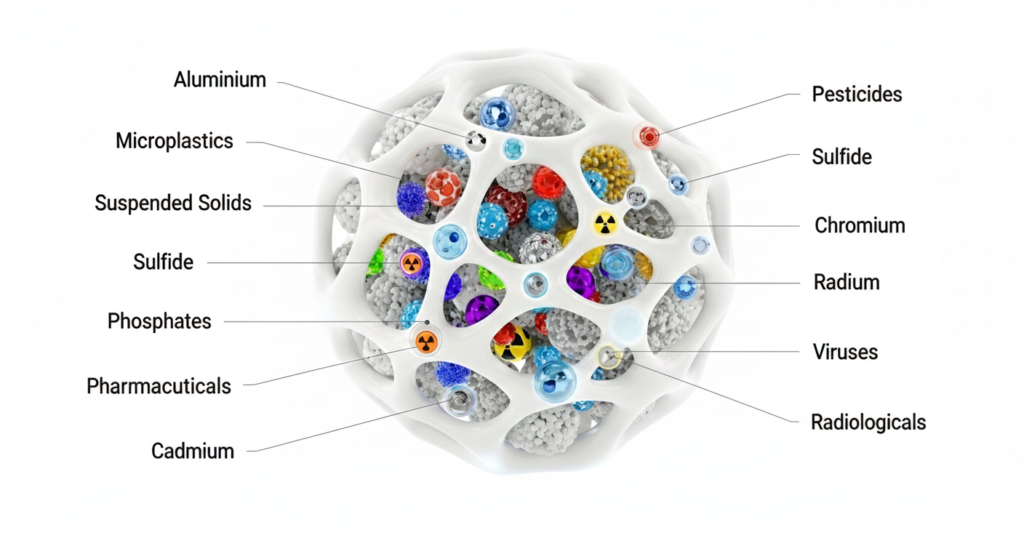
Nature’s Geometry, Perfected by Science.
At the heart of AquaZeo lies a sophisticated molecular sieve.
AquaZeo systems are built around clinoptilolite zeolite, a naturally occurring, microporous volcanic mineral with a unique negatively charged crystalline structure.
This isn’t just a filter; it’s a smart, selective purification process.
While traditional filters act like a simple mesh screen, AquaZeo utilizes a high-surface-area Zeolite matrix that works on three distinct levels:
Mechanical Interception: Our porous structure traps Suspended Solids and Microplastics that are invisible to the naked eye.
Ion Exchange: AquaZeo identifies and swaps harmless ions for harmful heavy metals. This is how we effectively “lock away” Aluminum, Cadmium, and Chromium.
Chemical Adsorption: Specialized binding sites neutralize complex organic compounds, including Pesticides and Pharmaceuticals, ensuring they never reach your glass.
The Core Filtration Mechanisms:
Ion Exchange: Zeolite’s honeycomb structure acts like a powerful magnet for positively charged ions (cations). As water passes through, harmful contaminants like Ammonium (NH4+), Lead (Pb2+), Arsenic (As3+), and Cadmium (Cd2+) are trapped, and in exchange, beneficial ions like sodium, potassium, calcium, and magnesium are released into the water.
Molecular Adsorption: The vast network of microscopic channels and cages acts as a “molecular sieve.” It can physically trap particles and adsorb certain organic molecules, chlorine by-products, and gases like hydrogen sulfide (which causes “rotten egg” smell), removing them from your water.
Catalytic & Bacterial Inhibition: The zeolite media creates an environment that can help catalyze the breakdown of some organic pollutants and inhibits bacterial growth on the filter media itself.